
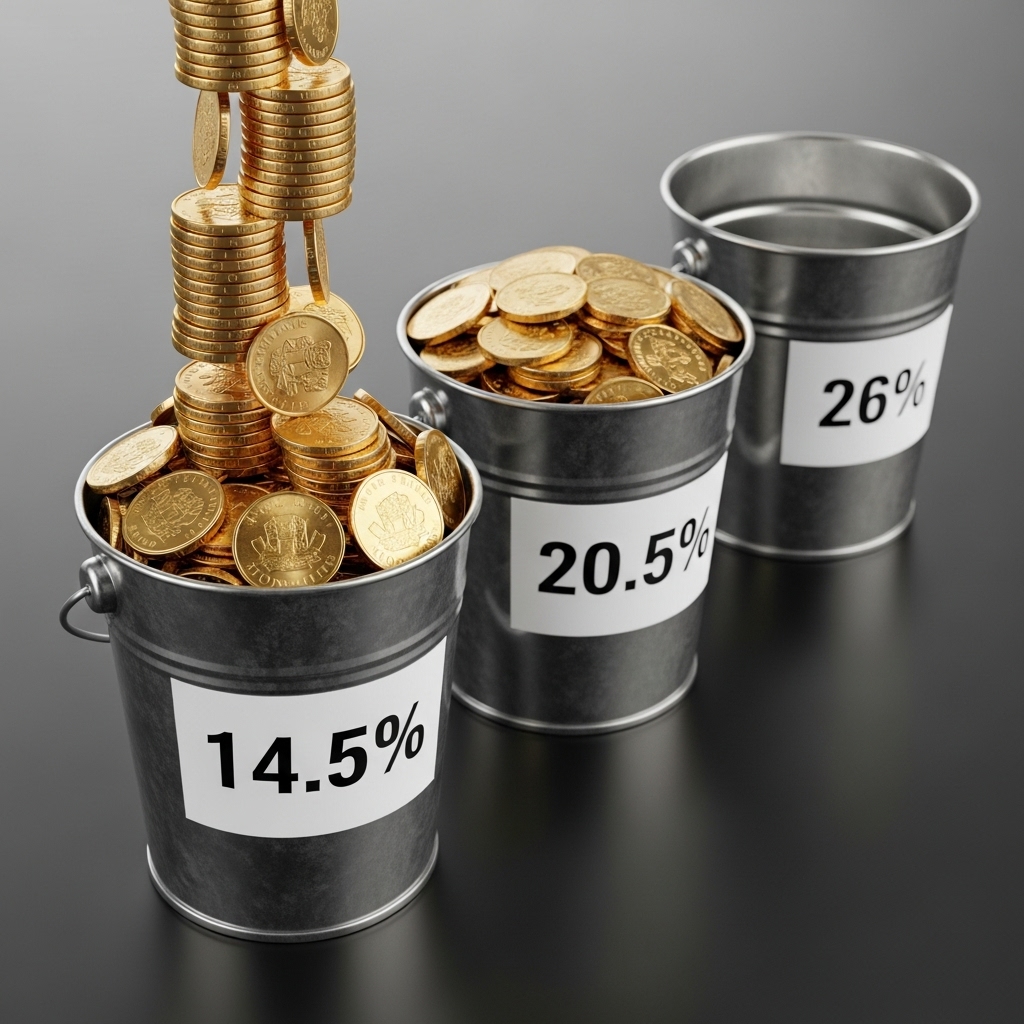
It is the single most common myth in Canadian personal finance: “If I get a raise, it will ‘bump’ me into a new tax bracket, and I’ll end up taking home less money than before.”
This belief is 100% false. In Canada’s tax system, a higher gross income will always result in a higher after-tax, take-home pay. This is a fact.
The confusion comes from a misunderstanding of two core concepts: your Marginal Tax Rate versus your Average Tax Rate. This guide, based on official 2025 government data, will explain how your taxes are really calculated.
The “Bucket” Analogy: How Tax Brackets Actually Work
Canada has a “progressive” or “graduated” tax system. The easiest way to understand this is to think of tax brackets as a series of “buckets.”
Your income starts filling the first, smallest bucket, which is taxed at the lowest rate. Once that bucket is full, the “overflow” spills into the second bucket, which is taxed at a higher rate. The overflow from that bucket spills into the third, and so on.
Crucially, the money in your first bucket is always taxed at the low rate. The higher rate only ever applies to the new money that spills into the next bucket. Your old money is safe.
The #1 Myth BUSTED (The Simple Math)
Let’s bust the “raise myth” with a clear, real-world example. We’ll use the 2025 federal tax brackets. The first bracket ends at $57,375, where the 14.5% rate jumps to 20.5%.
Imagine your income is $57,000, and you’re offered a $1,000 raise to $58,000. This raise pushes you across the bracket line.
Scenario A: Your Income is $57,000 (Before the Raise)
Your entire $57,000 is in the first “bucket” and is taxed at 14.5%.
Federal Tax: $57,000 x 14.5% = $8,265
Take-Home Pay: $57,000 – $8,265 = $48,735
Scenario B: Your Income is $58,000 (After the Raise)
This is where the “buckets” are key. Your tax is calculated in two parts:
- Tax on Bucket 1: The first $57,375 is taxed at 14.5% = $8,319
- Tax on Bucket 2: The “overflow” ($625) is taxed at 20.5% = $128
Total Federal Tax: $8,319 + $128 = $8,447
Take-Home Pay: $58,000 – $8,447 = $49,553
The Result:
By getting a $1,000 raise that “bumped” you into a new bracket, your take-home pay still increased by $818. You are always better off earning more money.
The Key Definitions: Marginal vs. Average Tax Rate
The reason the myth exists is that people confuse these two very different rates.
Marginal Tax Rate
This is the tax rate you pay on your next dollar earned. It’s the rate of the highest “bucket” your income reaches. In our example, your marginal tax rate on the raise was 20.5%. This is the most important number for financial planning (like deciding on an RRSP).
Average Tax Rate (or “Effective” Rate)
This is the actual percentage of your total income you pay in taxes. It’s your total tax bill divided by your total income. In our example, your average tax rate barely moved (from 14.5% to 14.56%). This is your true, blended tax rate.
Why This Is the Most Important Number You Need to Know
Knowing your marginal tax rate is the key to making smart financial decisions, especially for the RRSP vs. TFSA debate.
- The RRSP Strategy: The RRSP is a bet on your marginal tax rate. You contribute when your marginal rate is high (e.g., 42%) to get a big tax refund. The goal is to withdraw that money in retirement when your marginal rate is much lower (e.g., 23.9%).
- The TFSA Strategy: The TFSA is for everyone else. If your marginal tax rate is low (or you think it will be higher in retirement), you should prioritize the TFSA, where you pay tax now but your growth is tax-free forever.
2025 Federal Tax Brackets
Finally, your total tax bill is a combination of federal and provincial brackets “stacked” on top of each other. Here are the 2025 federal brackets, which are the foundation for all calculations in Canada (outside Quebec).
| 2025 Federal Tax Rate | Taxable Income Threshold |
|---|---|
| 14.5% | on the portion of taxable income that is $57,375 or less |
| 20.5% | on the portion of taxable income over $57,375 up to $114,750 |
| 26% | on the portion of taxable income over $114,750 up to $177,882 |
| 29% | on the portion of taxable income over $177,882 up to $253,414 |
| 33% | on the portion of taxable income over $253,414 |
(Data sourced from the Government of Canada)