
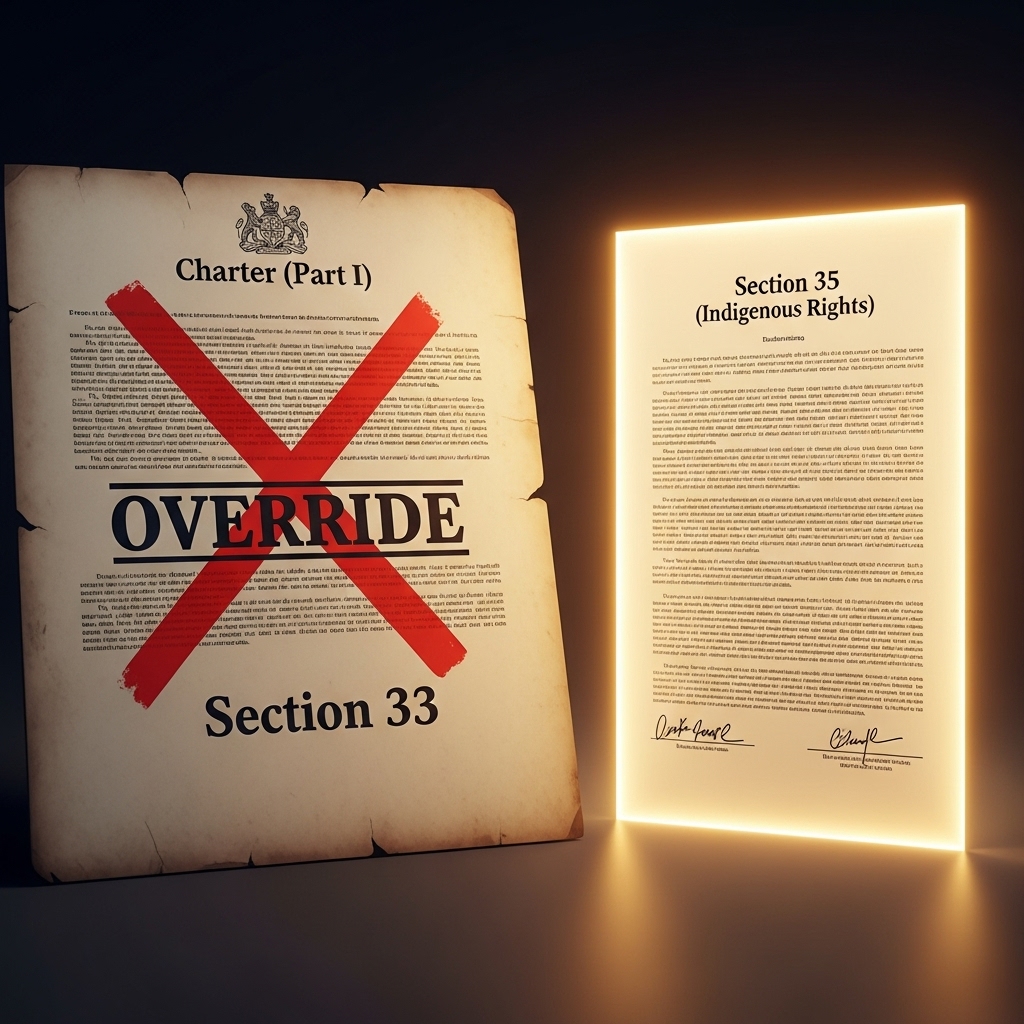
The Canadian Charter of Rights and Freedoms is arguably the most important legal document for the average Canadian. It’s the part of our Constitution that guarantees our fundamental freedoms, legal rights, and equality. But it’s also one of the most misunderstood.
Many Canadians believe their rights are absolute, or that the Charter protects them from their private employer. Neither is true. The Charter is a complex document of powerful rights and deliberate, crucial limits.
This is a plain-language guide to what your rights actually are, what they aren’t, and what the controversial “Notwithstanding Clause” really means.
Section 1: The Charter Explained (The 3 Big Myths)
The Charter was enacted in 1982 as Part I of the Constitution Act, 1982. It is the “supreme law of Canada,” meaning any law that’s inconsistent with it can be struck down by a court. But its power has specific and important limits.
Myth #1: “My rights apply everywhere.”
The Truth: The Charter protects you only from the government. Lawyers call this “vertical application.” It applies to federal, provincial, and municipal laws, as well as government actions (like police or public schools). The Charter does not apply “horizontally” to interactions between private citizens or businesses. Your private-sector boss firing you for something you said is not a Charter violation (though it might be a violation of a provincial Human Rights Code).
Myth #2: “My rights are absolute.”
The Truth: No right in the Charter is absolute. Section 1, the “Reasonable Limits Clause,” states that all Charter rights are “subject only to such reasonable limits prescribed by law as can be demonstrably justified in a free and democratic society.” This is the legal test courts use to balance individual rights against the needs of the greater public good (e.g., justifying limits on free speech to ban hate speech).
Myth #3: “The Charter and the Constitution are the same thing.”
The Truth: The Charter is only one part of the Constitution. The Constitution Act, 1982 is the “container” document. The Charter is Part I. This is a critical distinction because Part II of the Constitution contains Section 35, which recognizes and affirms Indigenous and Treaty rights. This separation is legally profound, as we’ll see in a moment.
Section 2: Your Key Rights in Plain Language
The Charter guarantees several categories of rights. Here are the ones that affect you most often.
- Fundamental Freedoms (Section 2): These are your basic “democratic society” rights: freedom of speech and expression, freedom of religion, and freedom of peaceful assembly (like protesting).
- Democratic Rights (Sections 3-5): This guarantees your right as a Canadian citizen to vote in elections and ensures governments must face an election at least every five years.
- Legal Rights (Sections 7-14): These protect you when dealing with the justice system. The most famous are Section 7 (the right to life, liberty, and security of the person) and Section 10 (the right to be informed of why you are being arrested and the right to a lawyer).
- Equality Rights (Section 15): This guarantees equal protection and benefit of the law “without discrimination” based on race, national or ethnic origin, colour, religion, sex, age, or mental or physical disability.
Section 3: The “Notwithstanding Clause” (Section 33) Explained
This is the most controversial, powerful, and misunderstood part of the Charter. It is at the center of Canada’s biggest political debates.
What It Is:
The “Notwithstanding Clause” (Section 33) is an “override power.” It allows the federal or a provincial government to pass a law that temporarily operates “notwithstanding” (or in spite of) the fact that it violates certain Charter rights.
How It Works:
- A government must explicitly declare it is using the clause in the text of a law.
- The override is only valid for 5 years (a “sunset clause”). After 5 years, it expires unless the government re-passes it.
Why It Exists:
Section 33 was a “political compromise” to get the Charter passed. Some provinces feared the Charter would give “unelected judges” too much power (judicial supremacy). Section 33 was the “safety valve” that ensured elected governments could have the final say on major issues (parliamentary supremacy).
What It Can (and Cannot) Override:
This is a key point. Section 33 cannot override the entire Charter. Its power is limited.
- It CAN override: Fundamental Freedoms (Section 2) and Legal & Equality Rights (Sections 7-15).
- It CANNOT override: Democratic Rights (like the right to vote), Mobility Rights, or Language Rights.
Section 4: The Most Important Distinction: The Charter vs. Indigenous Rights
This is a critical legal fact that is almost always missed in public debate. As we mentioned, the Charter is only Part I of the Constitution Act, 1982.
Part II of that same Constitution contains a single section: Section 35, which “recognizes and affirms” the “existing aboriginal and treaty rights of the aboriginal peoples of Canada.”
The “Constitutional Firewall”
Because Indigenous and Treaty rights are in Section 35 (Part II), they are not part of the Charter (Part I). This creates a “constitutional firewall.”
The Notwithstanding Clause (Section 33) explicitly states it can only override sections of the Charter. Therefore, it has no power over Section 35.
Aboriginal and Treaty rights, which you can read about in our explainer on Section 35, are the only rights in the Constitution that are protected from both the Section 1 “Reasonable Limits” test (they use a different, stricter test) and the Section 33 “Notwithstanding” override. This gives them a unique and more robust constitutional protection than even your fundamental freedoms.