
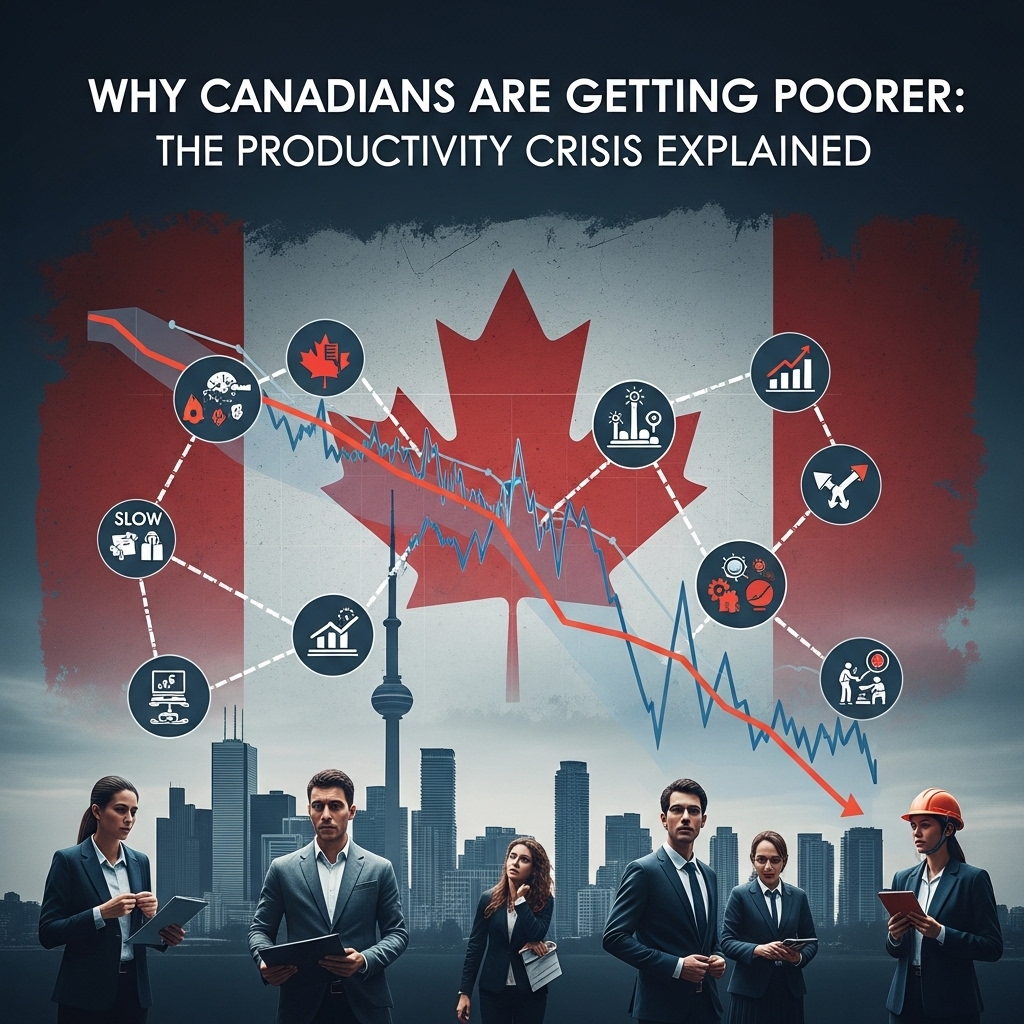
In March 2024, the Bank of Canada did something extraordinary. Senior Deputy Governor Carolyn Rogers declared a national economic emergency.
“You’ve seen those signs that say, ‘In emergency, break glass,'” she told a room of business leaders. “Well, it’s time to break the glass.”
She wasn’t talking about inflation or housing. She was talking about productivity—the hidden engine of our economy that has stalled. It is the reason why, despite working hard, many Canadians feel like they are falling behind. Here is a plain-language guide to the crisis, the myths, and why your wages are stuck.
Section 1: What is “Productivity”? (The Myth-Buster)
When economists say “productivity is low,” most people hear: “You aren’t working hard enough.” This is completely false. Canadians are some of the hardest workers in the world.
The Real Definition: Labour productivity is simply the amount of value created for every hour worked. It’s not about effort; it’s about efficiency.
The Analogy: Imagine two workers digging a hole.
• Worker A has a shovel. They work 10 hours, sweating and exhausted.
• Worker B has an excavator. They work 1 hour and dig a bigger hole.
Worker B is 10x more “productive,” not because they worked harder, but because they had better tools. Canada’s crisis is that our workforce is stuck with shovels while our competitors are buying excavators.
Section 2: The Data (How Bad Is It?)
The gap between Canada and the United States is widening at an alarming rate. According to the Royal Bank of Canada (RBC), Canada’s economic performance is now closer to Alabama than to wealthy states like California or New York.
- The Gap: A Canadian worker generates about $73 USD of value per hour. An American worker generates $97 USD. That’s a 25% gap.
- The Trend: In 1984, our productivity was 88% of the US level. Today, it has collapsed to 71%. We are falling behind.
- Standard of Living: Since 2019, our real GDP per capita (a measure of individual wealth) has actually declined by 2.5%. We are getting poorer.
Section 3: The Causes (Why Are We Falling Behind?)
This isn’t an accident. It’s the result of decades of under-investment and barriers.
1. The Investment Gap (The “58-Cent Dollar”)
Canadian businesses do not invest in their workers the way US companies do. For every $1.00 of new investment (machinery, software, AI) an American worker gets, a Canadian worker gets only 58 cents. This “capital shallowing” means our tools are older, slower, and less efficient.
2. Interprovincial Trade Barriers
It is often easier for a Canadian company to trade with Europe than with a neighboring province. Ridiculous rules—like different trucking hours in BC vs. Alberta, or unaligned construction codes—act as a “hidden tax” on our economy. The IMF estimates removing these internal walls could boost our GDP by 4%.
3. Lack of Competition
Canada’s economy is dominated by oligopolies in banking, telecom, and airlines. When a few big companies control the market, they have little incentive to innovate or invest in productivity. They can simply raise prices instead.
Section 4: Why This Hurts Your Wallet
This might sound like abstract economics, but it hits your bank account directly.
Productivity = Wages. Over the long run, you cannot be paid more than the value you create. Because Canadian productivity is stagnant, Canadian wages are stagnant. The productivity gap is costing the average Canadian approximately $20,000 per year in lost potential income.
This is the hidden cost of the crisis. It’s not just that things are getting more expensive (inflation); it’s that our ability to pay for them isn’t growing fast enough.
Section 5: How We Fix It
The solution isn’t to work longer hours. It’s to build a smarter economy.
- Unlock Investment: We need tax reforms that encourage businesses to buy new machinery and software.
- Smash Trade Barriers: Provinces must harmonize rules to create a true national market.
- Digitize: We need to help small businesses adopt cloud computing and AI to catch up to their global peers.
The “break the glass” warning was a wake-up call. Canada can no longer rely on just adding more people to grow the economy. To protect our standard of living, we must finally focus on how much value we create.