
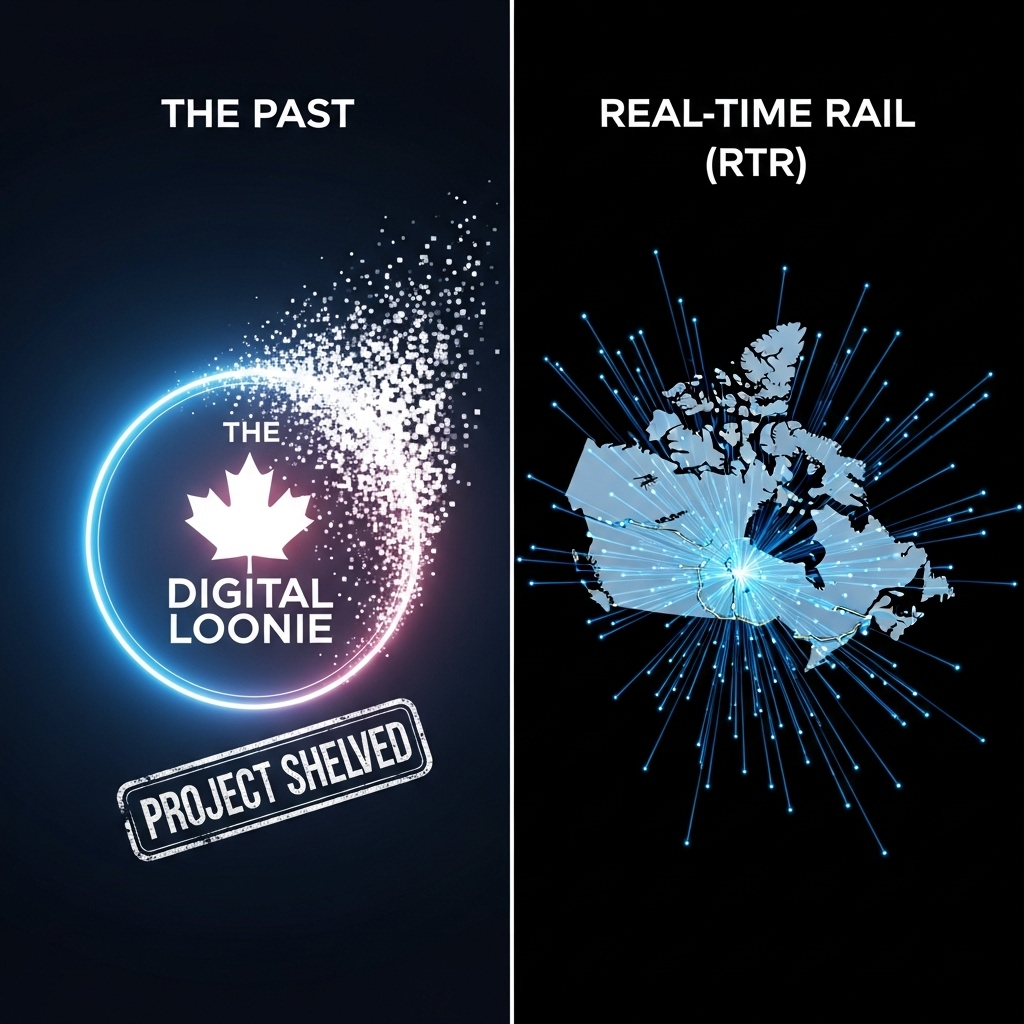
For five years, the “Digital Loonie” (Central Bank Digital Currency or CBDC) was the boogeyman of Canadian finance. Privacy advocates feared it. The crypto sector mocked it. Parliament debated it.
But in late 2025, the Bank of Canada quietly ended the experiment.
The project has been officially “scaled down” and shelved. But while the currency isn’t changing, the rails it moves on are about to undergo a massive overhaul. Here is the technical deep dive into why the CBDC died, and the Real-Time Rail (RTR) system launching in 2026 that will replace it.
The Verdict: “No Compelling Case”
The death of the Digital Loonie wasn’t caused by a technological failure; it was caused by a lack of demand.
In its final mandate update, the Bank of Canada admitted there was “no compelling case” to issue a state-backed crypto token. Why? Because Canada has a “Moat” that most other nations don’t: Interac.
Unlike other jurisdictions where CBDCs are needed to bank the unbanked, Canadians already have ubiquitous, cheap, digital payments. The Bank realized that building a taxpayer-funded competitor to a private system that already works would be a redundancy, not an innovation.
The Replacement: Meet the “Real-Time Rail” (RTR)
Just because the government isn’t minting a new coin doesn’t mean the system is staying the same. The Bank has shifted its resources to the Real-Time Rail (RTR).
Operated by Payments Canada, the RTR is the backend infrastructure expected to fully launch in 2026. It isn’t a new currency; it is a fiber-optic upgrade to the existing Canadian Dollar.
The Technical Specs (For the Pros):
- ISO 20022 Standard: Unlike current transfers which carry limited data, RTR payments carry rich metadata (invoices, tax details, and remittance info) directly inside the payment message.
- Finality of Settlement: This is the “killer feature.” Current e-Transfers can technically be reversed or held in specific fraud scenarios. RTR payments are irrevocable and settle in central bank funds instantly, 24/7/365.
- The “Good Funds” Model: The system verifies funds before the transaction initiates, eliminating the “NSF” (Non-Sufficient Funds) risk entirely for merchants.
The Privacy Win: Decoupling from “Programmable Money”
The shelving of the CBDC is a major victory for privacy advocates who feared “Programmable Money.”
A primary criticism of the Digital Loonie was the potential for the government to “expire” savings or restrict what money could be spent on (a concept theoretically possible with smart contracts). With the pivot to RTR, that threat is off the table.
The RTR moves standard commercial bank money. It is subject to existing privacy laws and banking charters, not new algorithmic controls. It makes money faster, not “smarter” in a way that compromises user autonomy.
The Scorecard: CBDC vs. RTR vs. Interac
For businesses planning their 2026 roadmaps, understanding the difference between these rails is critical.
| Feature | Digital Loonie (CBDC) | Real-Time Rail (RTR) | Interac e-Transfer |
|---|---|---|---|
| Status | CANCELLED | Live 2026 | Active (Legacy) |
| Currency Type | New Token (Liability of BoC) | Standard CAD (Commercial Bank) | Standard CAD |
| Settlement Speed | Instant | Instant (Sub-60 seconds) | Near Real-Time (30 mins) |
| Data Richness | High (Programmable) | High (ISO 20022) | Low (Text only) |
People Also Ask
Is the Bank of Canada still making a Digital Loonie?
No. As of late 2025, the Bank of Canada confirmed it has “scaled down” the project due to a lack of a compelling business case, effectively cancelling the retail CBDC.
What is the Real-Time Rail (RTR)?
The RTR is Canada’s new national payment system, launching in 2026. Operated by Payments Canada, it allows for irrevocable, instant transfer of funds 24/7, using the data-rich ISO 20022 standard.
Will cash be eliminated in Canada?
No. The Bank of Canada has explicitly stated that bank notes will continue to be printed and distributed as long as Canadians demand them. The RTR is an addition to, not a replacement for, cash.
What is ISO 20022?
ISO 20022 is the new global standard for payment messaging. It allows rich data (like invoices, tax info, and remittance details) to travel with the money, reducing administrative work for businesses.