
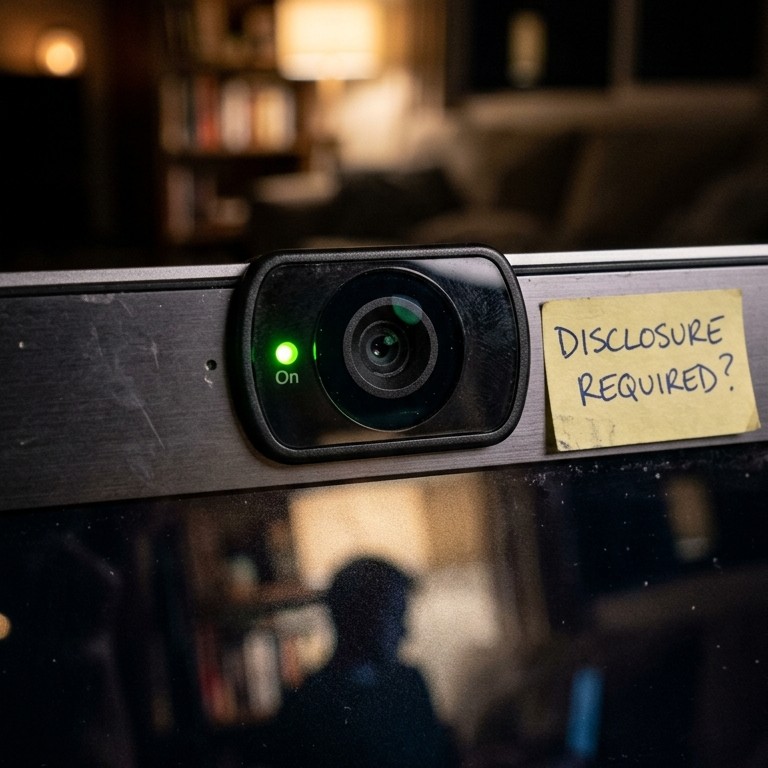
As the “July 2026” Return to Office (RTO) mandate looms over federal workers, those still clinging to hybrid and remote work are facing a new reality: the rise of AI-driven workplace surveillance.
From keystroke logging to “Active Presence” webcams that track eye movements, the technology to monitor remote workers has moved faster than the law. However, in 2026, Canadian courts and provincial regulators have finally begun to draw a line in the sand.
Here is the technical breakdown of your privacy rights, the new disclosure laws in Ontario and Quebec, and the “Reasonable Expectation of Privacy” in your own living room.
The Law: Transparency vs. Surveillance
In Canada, there is no single law that bans employee monitoring. Instead, it is a patchwork of provincial rules that focus on disclosure rather than prohibition.
Ontario (Working for Workers Act, 2026 Update):
If your employer has 25 or more employees, they must have a written Electronic Monitoring Policy. As of January 1, 2026, this policy must be updated to include the use of AI in performance scoring.
The Catch: The law doesn’t stop them from watching you; it only forces them to tell you how they are doing it.
Quebec (Law 25):
Quebec remains the strictest jurisdiction. Employers must prove that any monitoring is “proportionate” to a legitimate business goal. Constant webcam monitoring for “productivity” is generally considered illegal in Quebec because it is deemed too intrusive.
The 3 Levels of “Tattleware” in 2026
Not all monitoring is created equal. Here is what is currently being deployed across Canadian finance and tech sectors:
- Level 1: Metadata Tracking (Legal)
Tracking when you log into VPN, Teams, or Slack. This is universally legal as it uses company-owned infrastructure. - Level 2: Activity Monitoring (Grey Area)
Keystroke logging and screen capture. In most provinces (outside Quebec), this is legal if disclosed in your employment contract. - Level 3: Biometric/AI Surveillance (The Battleground)
AI software that uses your webcam to track “Active Engagement” or “Sentiment Analysis.” Canadian Privacy Commissioners are currently fighting to have this classified as “Sensitive Biometric Data,” which would require explicit, high-level consent.
The Scorecard: Your Rights at Home
| Activity | Is it Legal? (2026) | The Limitation |
|---|---|---|
| Webcam “Always On” | Unlikely. | Courts generally rule this violates “reasonable expectation of privacy” in a home. |
| Keystroke Logging | Yes. | Must be disclosed in a written Electronic Monitoring Policy (ON/QC). |
| Reading Private Emails | No. | Even on work laptops, personal accounts (Gmail/Outlook) are generally protected. |
| AI-Based Performance Scoring | Yes. | Ontario now requires disclosure if AI is used to “screen or assess” employees. |
People Also Ask
Can my employer watch me through my webcam in Canada?
Technically, they can only do so if it is for a specific, justified reason (like a secure exam or a sensitive client meeting). Constant “surveillance” via webcam is currently being challenged in Canadian courts as a violation of the Charter of Rights and Freedoms regarding the privacy of the home.
What is the Ontario Electronic Monitoring Policy?
It is a mandatory document for Ontario employers with 25+ staff. It must detail exactly what is being monitored (GPS, emails, chats, etc.) and for what purpose. If your company hasn’t provided you with this document, they may be in violation of the Employment Standards Act.
Is “Tattleware” legal for remote workers?
Yes, activity-tracking software (like Hubstaff or Time Doctor) is legal in most Canadian provinces, provided the employer has provided notice. However, if the software collects biometric data (facial recognition), the rules are much stricter.
Does my union protect me from AI surveillance?
Many unions, including PSAC and CAPE, have negotiated “Digital Rights” into their 2025/2026 collective agreements. These often limit the use of automated data for disciplinary purposes without human oversight.
Fed up with the digital eye? See why thousands of workers are choosing the 4-Day Work Week instead. Or, find out the latest on the July 2026 RTO Mandate.