
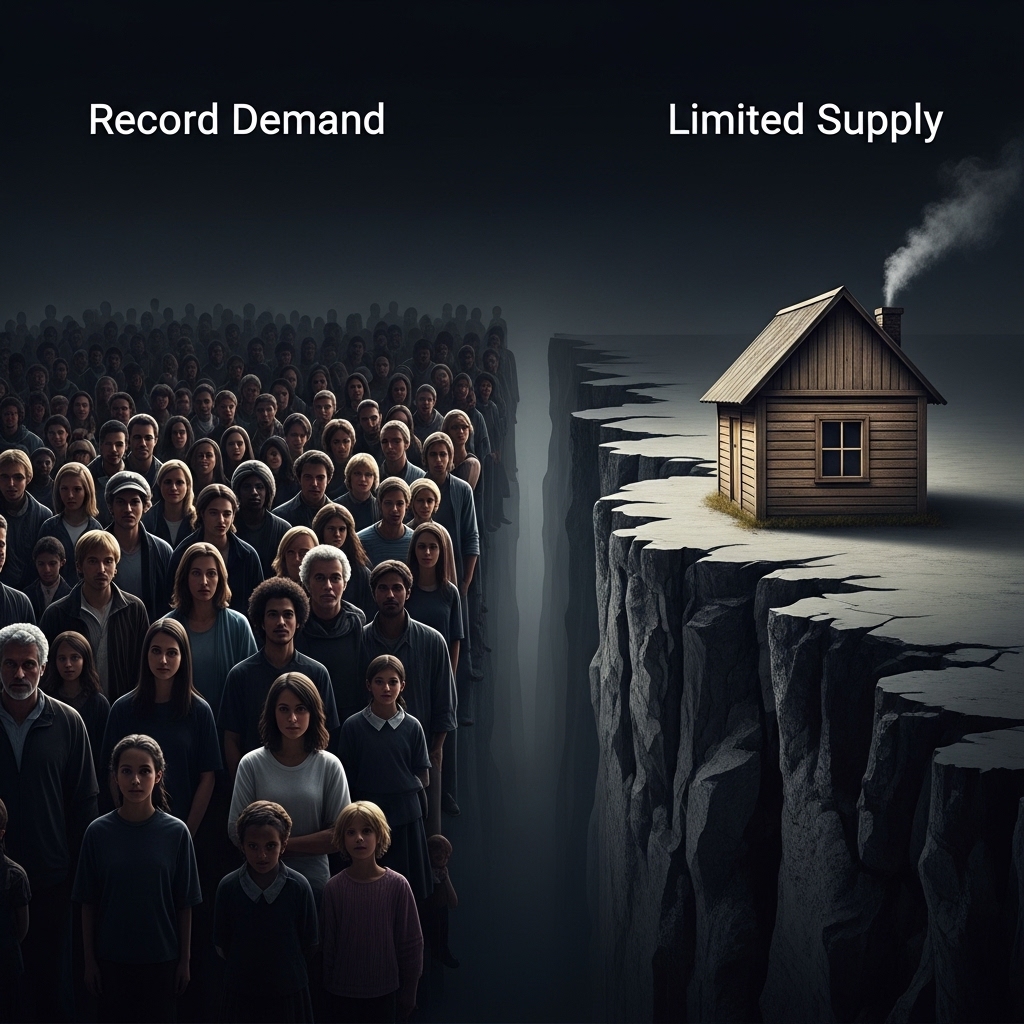
The Canadian housing market is broken. For millions of Canadians, the dream of homeownership has decoupled from reality, while renters face unprecedented costs and competition. It is a crisis of affordability, supply, and structural failure.
How did we get here? It wasn’t just one thing. It was a “perfect storm” of three massive forces colliding: a historic population shock, decades of restrictive zoning, and the financialization of housing.
Here is a plain-language guide to the structural disequilibrium of Canada’s housing market, the “supply gap” we face, and the radical policy pivots trying to fix it.
Part 1: The Perfect Storm (How We Got Here)
The crisis is the result of a widening gap between the number of people who need homes and the number of homes we actually build.
1. The Population Shock
In 2023, Canada’s population grew by 3.2%, the highest rate since 1957. This surge was driven almost entirely by temporary and permanent immigration. While this filled labour shortages, the housing market was structurally ill-equipped to absorb it. This sudden spike in demand, particularly from international students and temporary workers, crushed rental markets in cities like Toronto and Vancouver.
2. The “Yellowbelt” (The Zoning Problem)
For decades, major Canadian cities effectively illegalized density. In Toronto, a vast area known as the “Yellowbelt”—covering 70% of residential land—was zoned exclusively for single-detached homes. This forced all new housing into two extremes: expensive high-rise towers downtown or urban sprawl far away. We banned the “Missing Middle”—gentle density like triplexes and townhomes—creating a scarcity that inflated land values.
3. The “Condo-Investor” Trap
For 20 years, Canada relied on individual investors to buy pre-construction condos, which funded new development. High interest rates have broken this model. With mortgage costs soaring, investors are disappearing, leading to a wave of project cancellations that will cause a supply shortage in 2027-2028.
Part 2: The Supply Gap (The CMHC Number)
The scale of the shortage is staggering. The Canada Mortgage and Housing Corporation (CMHC) estimates that to restore affordability to 2004 levels by 2030, Canada needs to build 3.5 million *additional* homes above the current pace.
This means tripling our construction output—a feat constrained by a lack of skilled labour (carpenters, electricians) and soaring material costs. The Parliamentary Budget Officer offers a more conservative estimate of a 1.3 million unit gap, but even that remains a monumental challenge.
Part 3: The Solutions (The Policy Pivot)
In 2024 and 2025, the federal government initiated a series of radical policy shifts to address these root causes.
1. The Housing Accelerator Fund (HAF)
This $4 billion fund is using federal money to force municipalities to cut red tape. To get the funding, cities like Calgary, Halifax, and eventually Toronto had to agree to legalize four units as-of-right on residential lots, effectively ending the “Yellowbelt” era.
2. The GST Removal
To spur rental construction, the government removed the GST on new purpose-built rental projects. This tax break has already led to a surge in rental starts, making projects viable that were previously stalled by high interest rates.
3. The Population Cap
Recognizing the demand shock, the government has announced caps to reduce the number of temporary residents to 5% of the population. This is already softening rental demand in some student-heavy markets.
The Verdict: A Long Road Ahead
The era of cheap housing in Canada is over. The structural deficit is too large to be fixed overnight. However, the policy pivots of 2024-2025—unlocking zoning, incentivizing rentals, and managing demand—are the first steps toward a functional market.
The goal now is not to return to 2004 prices, but to arrest the spiraling costs and build a diverse supply of housing that ensures the era of inaccessible housing doesn’t become permanent.