
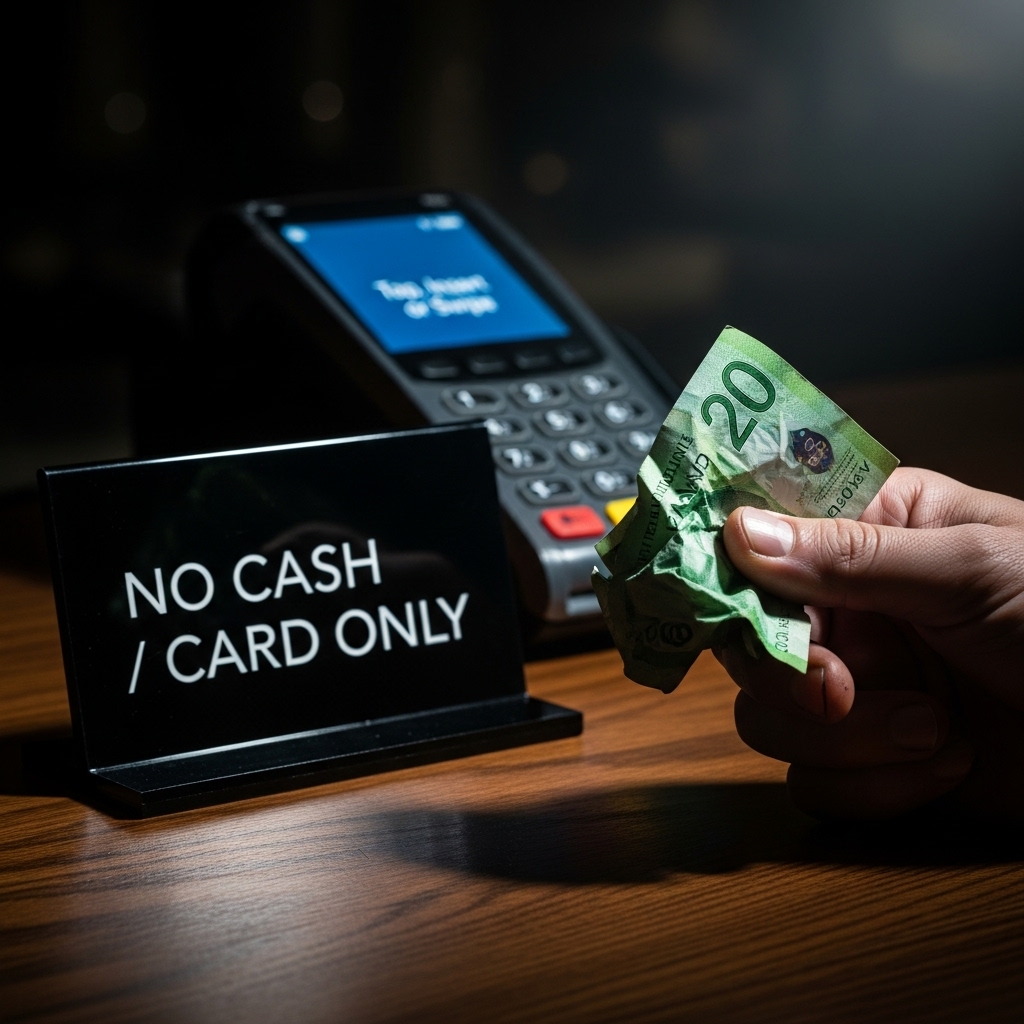
Walk into a coffee shop in downtown Toronto or Vancouver in 2026, and you might see a sign that makes your blood boil: “No Cash. Cards or Digital Only.”
For many Canadians, this feels like discrimination. Is it legal for a business to refuse your $20 bill? And with the rise of Digital ID, are we sleepwalking into a cashless society?
Here is the technical breakdown of the Currency Act, the rights of the retailer, and why “Cash is King” is losing its crown.
The Law: Can They Refuse My Money?
The short answer is: Yes.
Despite the popular belief that “legal tender” must be accepted for all debts, the Bank of Canada clarifies that this rule applies to paying off existing debts (like a tax bill or a loan), not buying a coffee.
The “Contract” Loophole: When you buy a latte, you are entering into a private contract with the merchant. Under Canadian law, businesses are free to set the terms of that contract—including the “method of payment”—as long as they disclose it before the transaction.
The Rule: If there is a sign on the door or at the register saying “Card Only,” they are legally in the clear. If they wait until after you’ve eaten a meal to tell you, that is a grey area, but generally, the sign rules.
The Risk: Why Businesses Are Ditching Cash
It isn’t a conspiracy; it’s an insurance policy.
1. The “Robbery Tax”: In 2024/2025, retail theft spiked across major metros. Holding cash makes a store a target. By going cashless, businesses remove the incentive for armed robbery.
2. The Efficiency: Counting a float, balancing a till, and doing a bank run takes roughly 5-8 hours of labour per week. In a high-wage environment (with minimum wage rising), cutting cash saves business owners ~$5,000 a year in labour.
The Scorecard: Cash vs. Digital
For the consumer, the choice between plastic and paper is becoming a political statement.
| Feature | Cash ($) | Digital (Card/Phone) |
|---|---|---|
| Privacy | 100% Anonymous. No tracking. | Tracked. Creates a data log. |
| Reliability | Works during power outages. | Fails if Rogers/Bell goes down. |
| Acceptance | Declining. (Refused at ~15% of urban cafes). | Universal. (Apple Wallet, Tap). |
People Also Ask
Is it illegal to refuse cash in Canada 2026?
No. According to the Bank of Canada, businesses are allowed to refuse cash and insist on other payment methods (like credit, debit, or digital wallets) as long as they notify the customer before the sale.
What is “Legal Tender” then?
“Legal tender” technically means that the currency must be accepted for settling an existing debt (like a court judgment or a tax bill). It does not force a private business to enter into a new sales contract with you if they prefer not to accept cash.
Are we moving to a cashless society?
Functionally, yes. While cash will legally circulate for decades, the convenience of tap-to-pay and the rise of Digital ID are making physical money a niche tool, primarily used for small transactions or privacy-focused purchases.
Does Digital ID replace my credit card?
Not yet. Digital ID (like the Ontario Digital ID app) verifies who you are, while your digital wallet (Apple Pay) handles the payment. However, the two systems are increasingly integrated on your phone for seamless transactions.
Worried about digital privacy? Read our report on Facial Recognition in Retail. Or, see why small businesses are struggling with the new Capital Gains Tax Hike.