
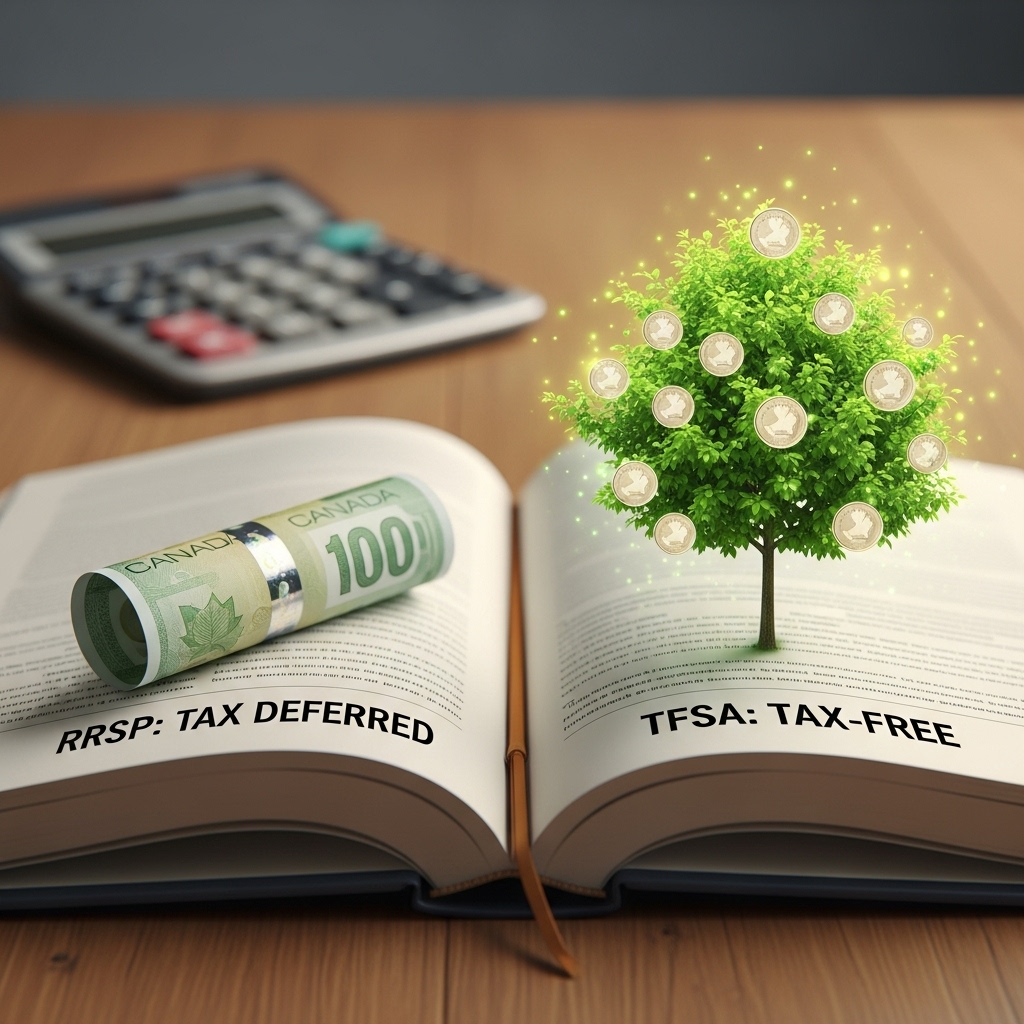
It is the single biggest financial question for most Canadians: “I have some money to save. Should it go into an RRSP or a TFSA?”
They are the two most powerful savings tools in the country, but they are built on opposite tax philosophies. Choosing the wrong one can cost you thousands of dollars. The Registered Retirement Savings Plan (RRSP) is a tax-deferred account, while the Tax-Free Savings Account (TFSA) is a tax-free account.
To make things more complicated, the new First Home Savings Account (FHSA) has completely changed the game. Here is a plain-language guide to finally answer which account is best for your specific situation.
The TFSA (Tax-Free Savings Account): Tax-Free Forever
The TFSA is a savings account where your money grows completely tax-free.
- The Concept: You contribute with after-tax dollars (you get no tax break today). But all your investment growth (interest, dividends, capital gains) and, most importantly, all your withdrawals are 100% tax-free, forever.
- The 2025 Limit: The annual limit for 2025 is $7,000.
- Lifetime Room: If you’ve been eligible since 2009 but never contributed, your total cumulative room in 2025 will be $102,000.
- Key Feature: You can withdraw money any time, tax-free. Any amount you withdraw is added back to your contribution room on January 1st of the *following* year.
The RRSP (Registered Retirement Savings Plan): Your Tax-Break Now
The RRSP is a savings account designed specifically for retirement. Its philosophy is to defer your taxes.
- The Concept: You contribute with pre-tax dollars. This means your contribution is tax-deductible, which reduces your taxable income today and usually results in a tax refund.
- The Downside: Your money grows tax-sheltered, but all future withdrawals are 100% taxed as regular income.
- The 2025 Limit: Your limit is 18% of your previous year’s earned income, up to a maximum of $32,490 for the 2025 tax year.
- Key Rule: When you withdraw money, that contribution room is gone forever.
- Exceptions: The two main exceptions where you can “borrow” from your RRSP tax-free are the Home Buyers’ Plan (HBP) (now up to $60,000) and the Lifelong Learning Plan (LLP).
The Golden Rule: When Do You Want Your Tax Break?
Here is the core difference. The best account for you depends entirely on your *tax bracket* today versus your *tax bracket* in retirement.
RULE 1: The RRSP is for a Tax Break NOW.
Prioritize an RRSP if you are in a **higher tax bracket today** than you expect to be in retirement.
Example: A 45-year-old earning $120,000 is in a high tax bracket (e.g., 45%). By contributing to an RRSP, they get a huge 45% tax break now. In retirement, they expect to be in a lower 25% bracket. When they withdraw the money, they only pay 25% tax, “winning” the 20% difference.
RULE 2: The TFSA is for a Tax Break LATER.
Prioritize a TFSA if you are in a **lower or similar tax bracket today** than you expect to be in retirement.
Example: A 25-year-old earning $50,000 is in a low tax bracket (e.g., 20%). Their RRSP tax break would be small. It’s better to pay their low 20% tax now, put the money in a TFSA, and let it grow for 40 years. When they retire, they can withdraw it all 100% tax-free, avoiding all future taxes.
The Expert Trap: Why TFSA is Safer for Many Seniors
There’s a hidden trap. RRSP withdrawals count as “income” in retirement, which can cause the government to “claw back” your Old Age Security (OAS) and Guaranteed Income Supplement (GIS) benefits. TFSA withdrawals do not count as income and have zero impact on your benefits. For low-to-moderate-income seniors, the TFSA is the only account that guarantees a 0% tax rate and protects their government benefits.
The Game-Changer: The First Home Savings Account (FHSA)
The “RRSP vs. TFSA” debate for a down payment is now over. The **First Home Savings Account (FHSA)**, introduced in 2023, is the new #1 choice for one specific goal: buying a first home.
It is a hybrid account that offers the “best of both worlds”:
- You get a tax deduction when you contribute (like an RRSP).
- Your money grows and is withdrawn tax-free for a home purchase (like a TFSA).
With an annual limit of $8,000 and a lifetime limit of $40,000, the FHSA is mathematically superior to the RRSP Home Buyers’ Plan for this one goal.
The Verdict: Your Savings “Order of Operations”
For most Canadians, the choice isn’t “RRSP or TFSA?” The best strategy is a priority list. Here is the modern order of operations for your savings:
PRIORITY 1: First Home Savings Account (FHSA)
If you are eligible to open one and are saving for a first home, every available dollar should go here first, up to the $8,000 annual limit.
PRIORITY 2: Tax-Free Savings Account (TFSA)
Once your FHSA is maxed (or if you’re not a first-time home buyer), fill your TFSA. This builds your flexible, tax-free foundation for emergencies, short-term goals, and tax-free retirement income.
PRIORITY 3: Registered Retirement Savings Plan (RRSP)
Once your FHSA and TFSA are full, use your RRSP for long-term retirement savings. This is especially true if you are in your peak earning years. (A pro tip: take the tax refund you get from your RRSP contribution and use it to fund next year’s TFSA!)
This strategy covers Pillar 3 (Private Savings) of your retirement plan, which works alongside Pillar 2 (your Canada Pension Plan) and Pillar 1 (Old Age Security) to build a secure financial future.