
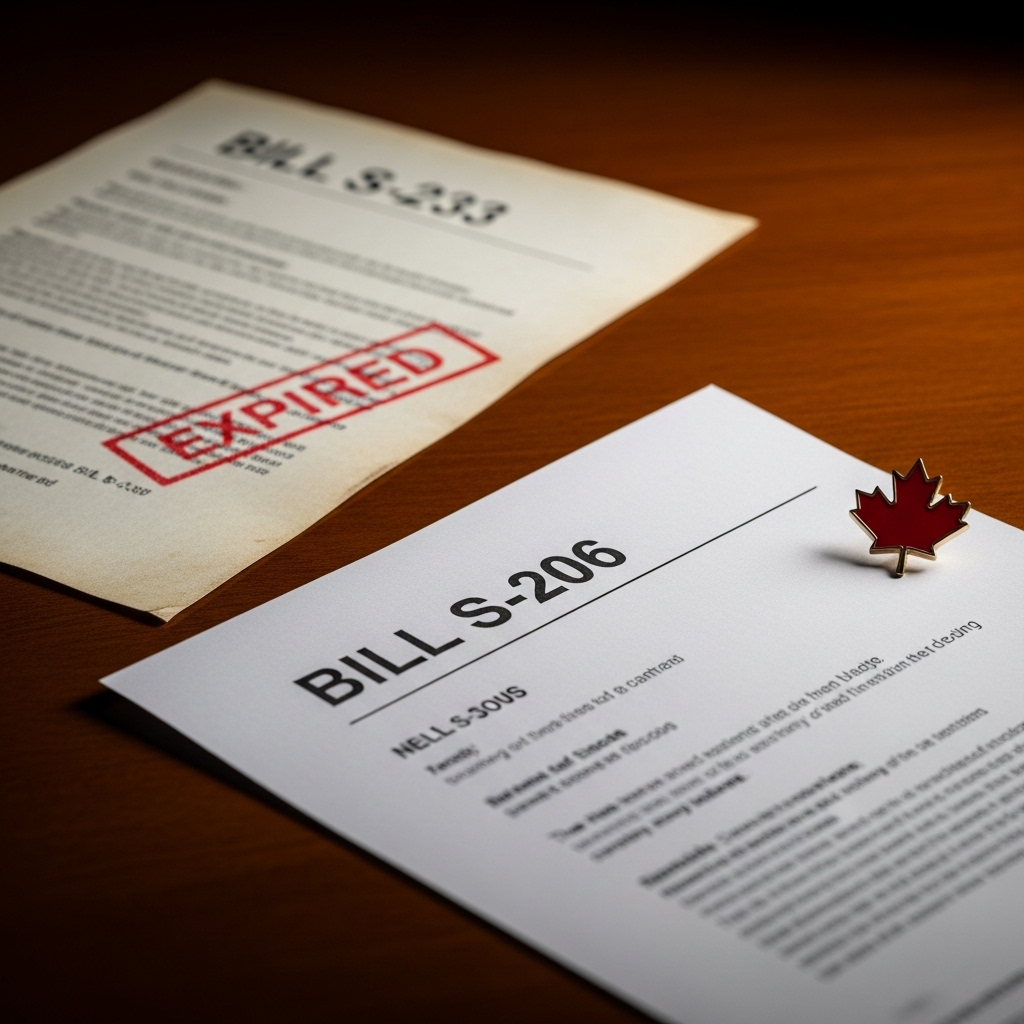
If you are searching for the status of Bill S-233, you are looking for a ghost.
For years, Bill S-233 was the rallying cry for basic income advocates in Canada. But as of January 2026, that bill is dead. It expired on the order paper when the previous Parliament dissolved.
However, the movement has pivoted. A refined, “version 2.0” piece of legislation—Bill S-206—is currently active in the Senate. Here is the definitive update on the new bill, the death of the “Digital Loonie,” and the reality of UBI in 2026.
Part 1: The “Zombie Bill” Warning (Stop Searching for S-233)
There is a dangerous confusion happening in search engines right now.
If you search for “Bill S-233” today, you might see a bill listed as “Active.” Do not be fooled.
In the current parliamentary session, Bill S-233 is a completely different law regarding assaults on health care workers. It has nothing to do with basic income. The “Basic Income” version of S-233 is a legislative corpse.
The entire UBI file has migrated to a new vehicle: Bill S-206.
Part 2: Meet Bill S-206 (The New Strategy)
Introduced by Senator Kim Pate on May 28, 2025, Bill S-206 is the National Framework for a Guaranteed Livable Basic Income Act.
Unlike its predecessor, this bill is moving fast. On November 6, 2025, it passed Second Reading and is currently under deep study by the Standing Senate Committee on National Finance.
Three Key Upgrades in the New Bill:
- The “Livable” Definition: The bill abandons the idea of a flat $2,000 cheque. Instead, Clause 3(1)(a) mandates that the benefit must reflect the specific cost of living in each region (e.g., Toronto vs. rural New Brunswick).
- The “Disability Shield”: To address fears that UBI would replace disability support, Clause 3(1)(d) explicitly forbids the program from resulting in a decrease of services or benefits for people with exceptional health needs.
- No Work Requirement: Perhaps the most controversial clause, 3(1)(c), ensures that participation in the labour market cannot be a condition for receiving the money.
Part 3: The “Digital Loonie” is Dead
For years, UBI discourse was haunted by conspiracy theories that the money would be paid via a “Central Bank Digital Currency” (CBDC)—programmable tokens that the government could track or control.
That narrative is now dead.
In late 2024, the Bank of Canada officially announced it has “scaled down” and effectively shelved its retail CBDC project. The Bank cited a “lack of a compelling business case.”
This is a strategic win for UBI advocates. It decouples the social policy (poverty reduction) from the controversial technology (digital currency). If S-206 passes, the money will be “dumb money”—standard direct deposits sent via the CRA, identical to the Canada Child Benefit.
Part 4: The Fiscal Reality (The $107 Billion Question)
While the bill has cleared legislative hurdles, it is now facing the “Final Boss”: The Senate Finance Committee.
The Parliamentary Budget Officer (PBO) has estimated that a Guaranteed Livable Basic Income could cost the federal treasury between $80 billion and $107 billion annually.
To put that in perspective, that is roughly equal to the total amount of GST collected by the government. Critics, including Senator Michael MacDonald, argue this would require a “wholesale overhaul of Canada’s tax system.” Proponents argue the net cost is lower once you account for the economic growth and reduced poverty costs.
What Happens Next?
As of early 2026, the bill is in the Committee Stage. This is where the rubber meets the road.
If it survives the committee (likely later this Spring), it will face a final Senate vote. However, even if it passes the Senate, it must start the entire process over again in the House of Commons. The dream is alive, but it is still a long legislative road.