
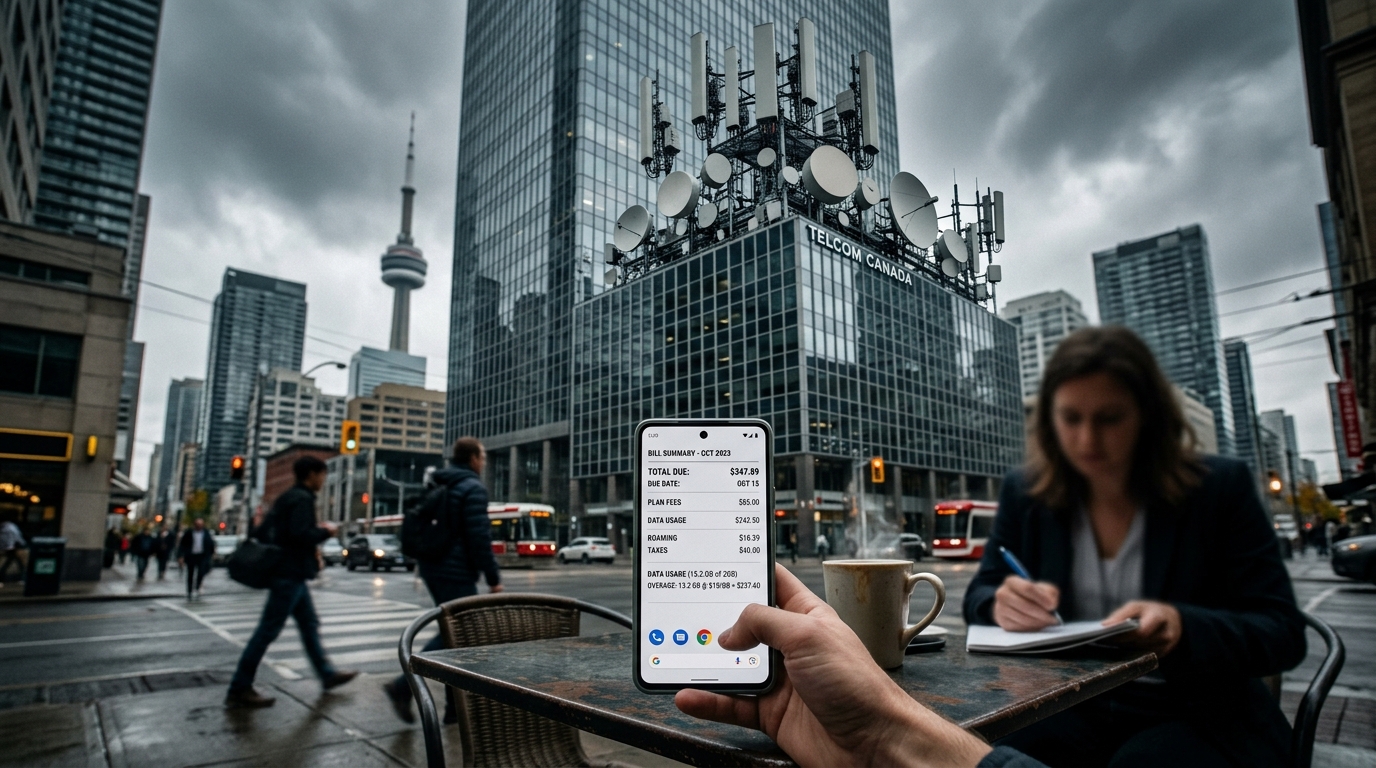
Despite repeated regulatory overhauls, parliamentary committee hearings, and election campaign pledges, Canadian consumers continue to shoulder the highest wireless telecommunications bills in the industrialized world in 2026. An average Canadian family of four pays over $2,600 annually for cellular connectivity — more than double what equivalent households pay across the United Kingdom, France, or Australia for identical 5G data allotments.
- Oligopoly Market Control: Rogers, Bell, and Telus control over 88% of all Canadian wireless subscribers and spectrum licenses.
- Global Price Penalty: Canadians pay an average of $6.20 per GB of high-speed data, compared to $0.42/GB in France and $1.15/GB in the UK.
- Failed MVNO Mandates: The CRTC’s facilities-based wholesale framework has prevented true independent low-cost discount carriers from competing on equal footing.
As documented across our consumer pricing investigations on hidden bank fees draining Canadian households, credit card checkout surcharges, and supply management price premiums, Canada’s economy is increasingly structured around protected domestic oligopolies that insulate corporations from genuine global competition.
1. How the Big 3 Engineered a Wholesale Moat
In most competitive global markets (such as Europe and the United States), independent Mobile Virtual Network Operators (MVNOs) like Mint Mobile, Giffgaff, and Free Mobile buy network capacity at true wholesale cost and pass massive savings to consumers. In Canada, the Canadian Radio-television and Telecommunications Commission (CRTC) designed a “facilities-based” mandate: an MVNO can only buy wholesale access if they already own physical cell towers and pledge to build out redundant infrastructure within seven years. This structural catch-22 effectively locked out nimble independent discounters, leaving wholesale access restricted to regional incumbents.
2. G7 Wireless Price & Profitability Comparison
Wireless Plan Pricing & EBITDA Margins Across the G7 (2026 Benchmark)
| Country | Avg. 50GB 5G Plan (CAD) | Effective Cost / GB | Carrier EBITDA Operating Margin |
|---|---|---|---|
| Canada (Rogers/Bell/Telus) | $62.00 / mo | $1.24 / GB | 44.8% (World-Leading) |
| United States (Verizon/T-Mobile) | $48.00 / mo | $0.96 / GB | 36.2% |
| United Kingdom (EE/O2/Vodafone) | $24.50 / mo | $0.49 / GB | 28.5% |
| France (Free/Orange) | $18.00 / mo | $0.36 / GB | 24.1% |
| Australia (Telstra/Optus) | $32.00 / mo | $0.64 / GB | 31.0% |
3. The Path Forward: True Open Wholesale Access
Canadian telcos argue that Canada’s vast geography requires higher capital expenditures per subscriber. However, Australia has a virtually identical geographic landmass and rural population density, yet Australian consumers pay roughly half what Canadians pay while enjoying robust national coverage. Until the federal government and CRTC mandate unconditional open-access wholesale rates to pure MVNO discounters and unbundle spectrum rights, Canadian households will remain locked in a captive market.
People Also Ask
Why are cell phone plans so expensive in Canada?
Canada’s wireless market is controlled by an oligopoly (Rogers, Bell, Telus) that holds over 88% of subscribers. Weak wholesale regulations and restrictions on pure Mobile Virtual Network Operators (MVNOs) prevent international price competition.
How do Canadian wireless bills compare to the US and Europe?
Canadians pay approximately 30% to 50% more than Americans and up to 250% more than consumers in France and the UK for equivalent 5G data packages.
What is an MVNO in Canada?
A Mobile Virtual Network Operator (MVNO) is a carrier that does not own cellular towers but buys network access wholesale to offer budget plans. Under current CRTC rules, MVNO access is restricted to companies that already own physical infrastructure.