
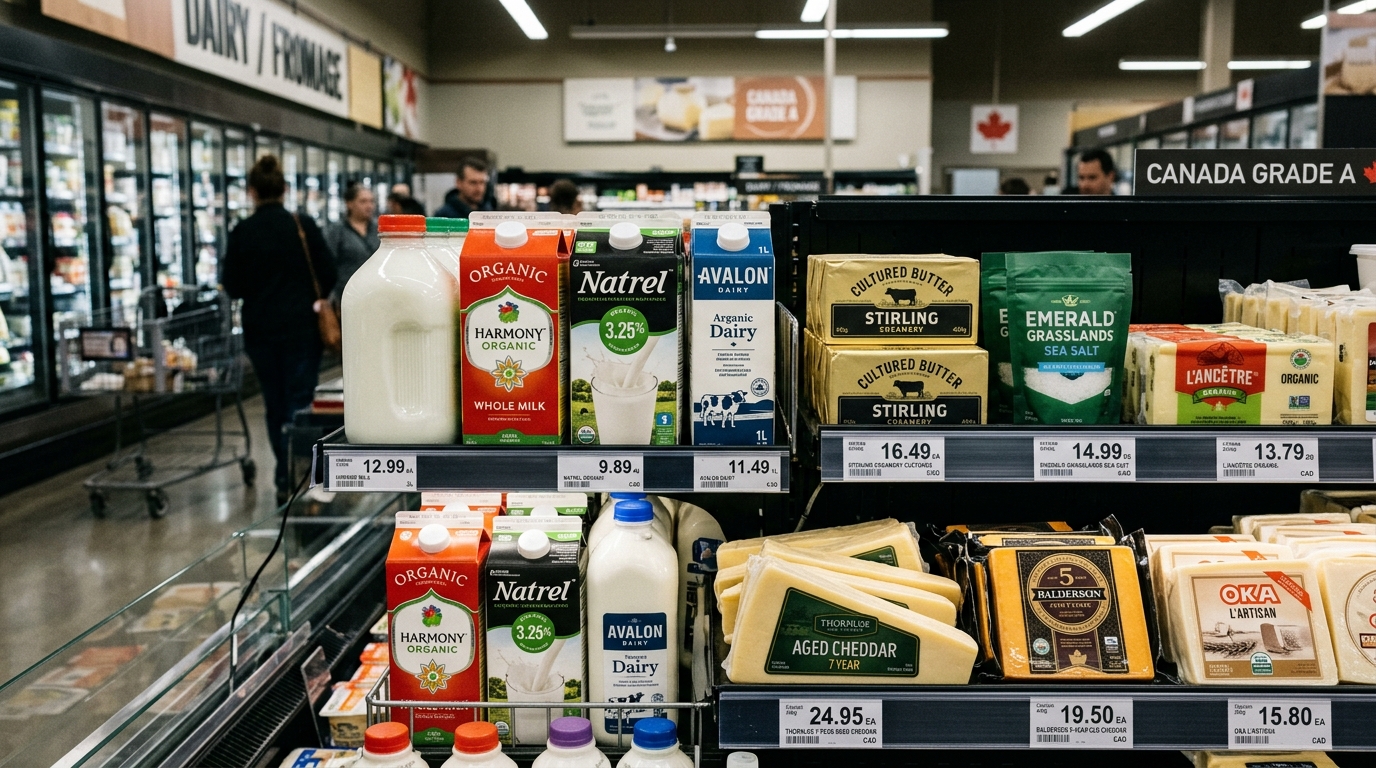
Walk into any grocery store in Buffalo, New York, and a four-litre jug of whole milk costs roughly $3.40 USD ($4.60 CAD). Drive forty minutes north across the Peace Bridge into Fort Erie, Ontario, and an equivalent jug of Canadian milk costs $6.89 to $7.49 CAD. A 400-gram block of standard Canadian cheddar sells for $8.99 to $10.49; across the border, comparable cheese is $4.20 CAD. Canadians are not paying more because Canadian cows are more expensive to feed. They are paying a legally mandated structural premium to maintain a government-enforced agricultural cartel.
As The Northern Star has documented across investigations into how five grocery chains control 80% of Canada’s food retail, the $100 billion provincial trade barriers dividing our economy, and the compounding cost-of-living squeeze hitting Canadian household budgets, Canada’s supply management system is one of the most durable, politically untouchable price-fixing frameworks in the democratic world.
1. How Supply Management Actually Works: Production Quotas and 270% Tariffs
Created in the 1970s, Canada’s supply management regime governs three agricultural sectors: dairy, poultry (chicken and turkey), and eggs. It operates on three rigid pillars:
- Production Quota (Supply Control): Farmers cannot simply buy cows and sell milk. They must purchase production quota from provincial dairy boards. In 2026, the quota to milk a single cow costs approximately $28,000 to $32,000 CAD. A standard 100-cow farm requires $3 million in quota assets before purchasing land, barns, or equipment.
- Cost-of-Production Pricing (Guaranteed Returns): The Canadian Dairy Commission (CDC) conducts annual reviews and mandates minimum wholesale prices based on farm production costs. Price increases are routinely approved regardless of market demand or consumer purchasing power.
- Prohibitive Import Tariffs (Border Wall): To prevent cheaper foreign dairy from entering, Canada levies tariff-rate quotas with punitive over-quota duties: 241% on milk, 245% on cheese, and 298% on butter.
2. The Consumer Balance Sheet: Who Pays the Bill?
Because food is an inelastic necessity, supply management functions as a highly regressive tax. Lower-income families spend a significantly higher percentage of disposable income on basic groceries like milk, cheese, and eggs:
Dairy Price Comparison: Canada vs. US & EU Averages (2026)
| Staple Dairy Item | Canada (Avg Retail) | US (CAD Equivalent) | EU (CAD Equivalent) | Canadian Premium |
|---|---|---|---|---|
| Whole Milk (4 Litres) | $7.19 | $4.65 | $4.90 | +54% |
| Block Cheddar (400g) | $9.49 | $4.25 | $4.80 | +123% |
| Salted Butter (454g) | $7.99 | $4.80 | $5.10 | +66% |
| Dozen Large Eggs | $4.89 | $3.10 | $3.40 | +57% |
People Also Ask
Why is cheese so expensive in Canada in 2026?
Canada’s supply management system strictly limits the domestic production of milk through expensive production quotas and places tariffs of 245% to 298% on imported cheese and butter, preventing competition and keeping consumer retail prices artificially elevated.
What is supply management in Canada?
Supply management is a federal and provincial regulatory system controlling the price, production volume, and import tariffs for dairy, poultry, and eggs. It guarantees revenue stability for farmers while setting retail floor prices paid by Canadian consumers.
Will Canada ever end dairy supply management?
Full dismantling is unlikely due to strong political lobbies in Quebec and Ontario, though international trade pressure (such as USMCA renegotiations) continues to force modest quota concessions for imported dairy products.