
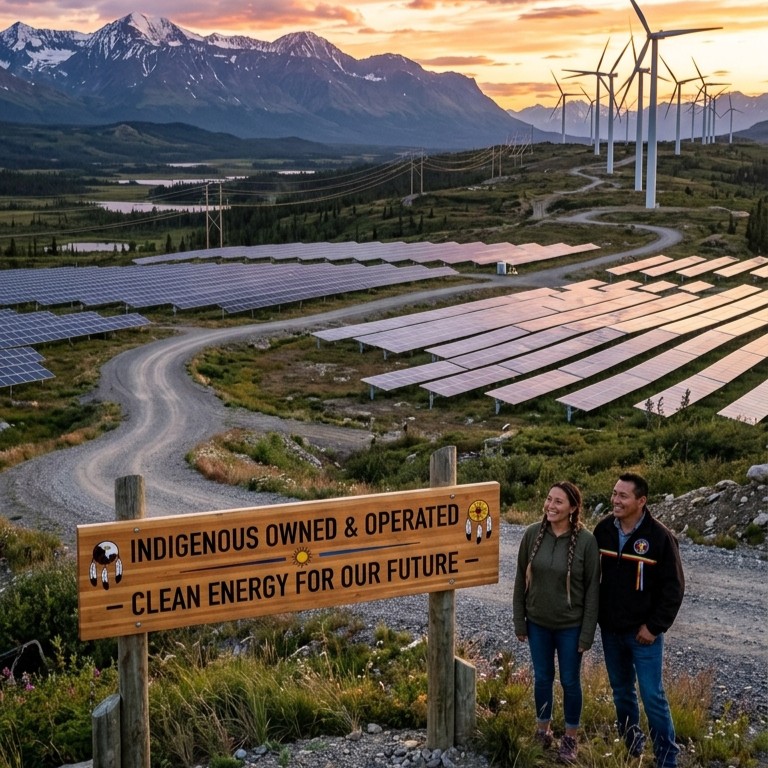
For a century, Canada’s electricity has been a “top-down” game. Provincial utilities like BC Hydro, Hydro-Québec, and Ontario Power Generation held all the cards, deciding who got power and at what price.
In 2026, the game is changing. Tired of aging infrastructure, rising delivery fees, and “colonial” grid planning, Indigenous nations are taking control of the switch. They aren’t just participating in the energy transition; they are leading it by building independent power systems that bypass traditional provincial boundaries.
Here is the technical breakdown of the new National Energy Corridor, the rise of Indigenous micro-grids, and why “Energy Sovereignty” is the next frontier of Section 35 rights.
The Landmark “National Energy Corridor” (March 2026)
On March 4, 2026, a historic agreement was signed by Alberta, BC, Manitoba, New Brunswick, Ontario, and five other jurisdictions. This partnership aims to build a “National Grid” that allows provinces to share power east-west—something that has been impossible for decades due to internal trade barriers.
The Indigenous Veto: Unlike previous “nation-building” projects, this corridor cannot be built without Indigenous equity. The Federal Government has made it clear: no Indigenous co-ownership, no federal funding. This has turned First Nations from “stakeholders” into the primary infrastructure partners for the country’s clean growth.
Bypassing the Grid: The Rise of Micro-Grids
While the provinces plan big wires, remote and northern communities are moving faster with Distributed Energy Resources (DERs).
In the “Golden Triangle” of Northwest BC and the Athabasca Basin in Saskatchewan, Indigenous-led projects are now generating power locally for critical mineral mines. By building their own solar, wind, and battery storage “micro-grids,” these nations are achieving three things:
- Reliability: They no longer rely on a single transmission line that can be cut by a wildfire or storm.
- Revenue: They sell surplus power directly to industrial users at a profit, bypassing provincial middle-men.
- Decarbonization: They are aggressively retiring diesel generators that have powered the North for 50 years.
The Scorecard: 2020 vs. 2026
The scale of Indigenous involvement in the power sector has shifted from “symbolic” to “structural.”
| Metric | 2020 Baseline | 2026 Reality |
|---|---|---|
| Project Ownership | Minority/Beneficiary (5-10%) | Majority/Full Ownership (51%+) |
| Grid Integration | Passive (Connected to Utility) | Active (Leading Transmission Lines) |
| Clean Energy Scale | Small Community Solar | Grid-Scale (Wind Farms/Battery Hubs) |
| Federal Funding | Grant-based (One-off) | Loan Guarantees (Billions available) |
People Also Ask
What is the First Nations Clean Energy Network?
It is a collaborative platform that supports First Nations in leading clean energy projects. In 2026, it has become a global model, with Canada and Australia forming a “Clean Energy Partnership” based on these Indigenous-led strategies.
Can Indigenous communities sell power back to the grid?
Yes. Many provinces have updated their “Call for Power” rules in 2025/2026 to allow (and encourage) Indigenous-owned projects to feed energy back into the main provincial grids at competitive rates.
How does the Indigenous Loan Guarantee Program work?
Announced in previous budgets and fully operational in 2026, the CILGC program provides federal guarantees for loans, allowing First Nations to access the massive capital needed to buy equity in billion-dollar transmission and generation projects.
Why are micro-grids better for the North?
Micro-grids allow a community to disconnect from the main grid if there is a failure, or operate entirely independently. This is crucial for energy security in remote areas where “the end of the line” is often vulnerable to weather and maintenance delays.
Looking for more on how Indigenous rights are shaping Canada? Read our guide on Section 35 and the Constitution. Or, see how the July 2026 RTO Mandate is impacting workers across the country.