
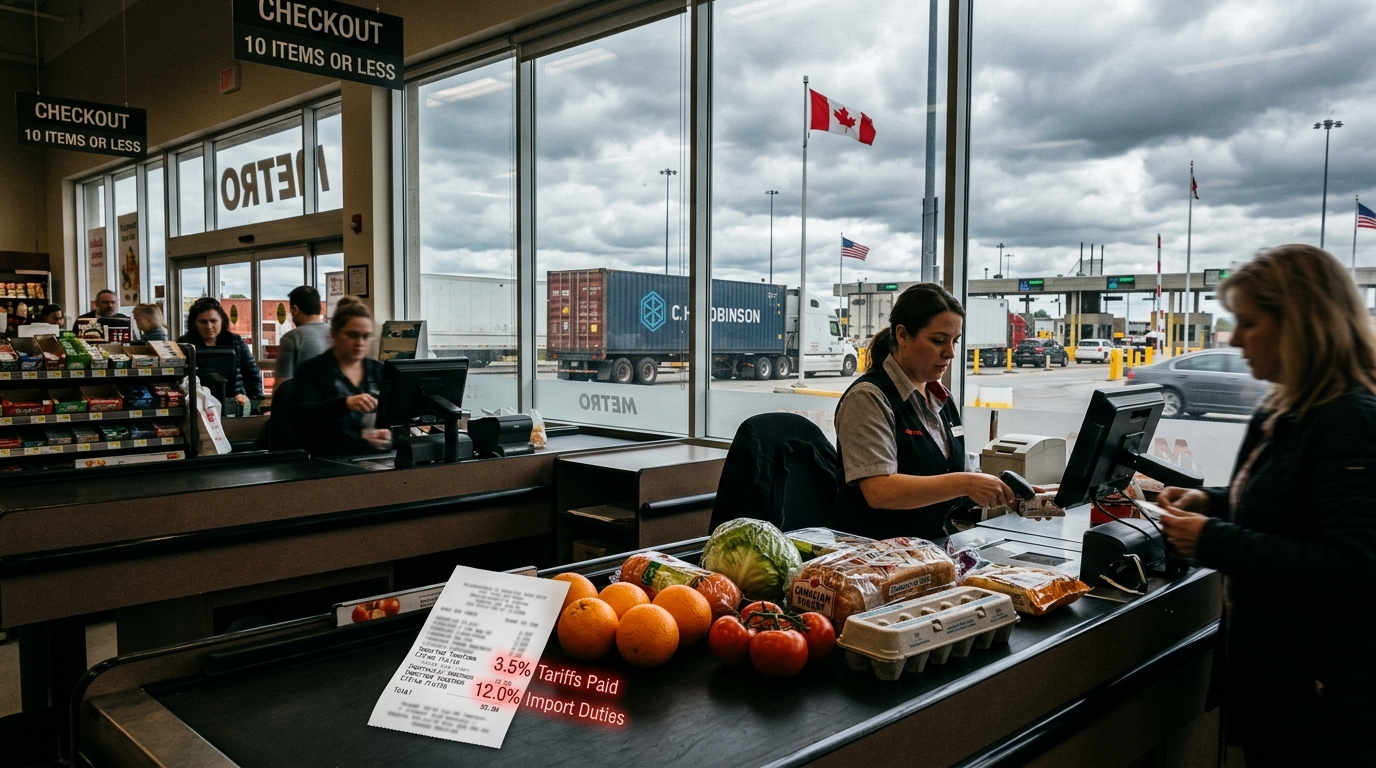
Cross-border trade disputes between Canada and the United States are often described in abstract diplomatic language: tariff schedules, rules of origin, and sovereign countervailing duties. Yet for the 41 million Canadians managing household budgets in 2026, international trade policy is not an academic debate—it is an immediate cost added directly to the grocery checkout scanner, the gas pump, and the online shopping cart. As explored across our investigative directives on the broader 2026 U.S.–Canada trade war, domestic food supply management cartels, and the $30 billion auto manufacturing battle, tariffs act as a regressive sales tax paid directly by domestic consumers.
With cross-border tariff threats escalating to 25% across bilateral trade corridors, everyday citizens are searching for clear, unvarnished facts. Which store items will actually surge in price? Will energy and heating bills spike? And how does cross-border e-commerce function under heightened border enforcement? Here is the complete, fact-checked 2026 Consumer Tariff Hit List and survival guide.
1. The Grocery Aisle Breakdown: What Spikes First
Canada’s climate creates an inevitable seasonal dependency on American agricultural supply chains, particularly during the late autumn, winter, and early spring months:
- Fresh Produce (California & Florida Imports): Canada imports over $7.2 billion in fresh vegetables, berries, citrus fruits, and leafy greens annually from the U.S. A 25% tariff would immediately inflate supermarket prices on oranges, strawberries, lettuce, and tomatoes by an estimated 15% to 22% within 14 days of enactment.
- Prepared Foods & Packaged Goods: Thousands of household pantry staples—from breakfast cereals and canned soups to condiments and peanut butter—are manufactured in Midwestern U.S. facilities. Retailers like Loblaws, Metro, and Sobeys would pass import surcharges directly onto shelf retail prices.
- Packaging & Processing Input Costs: Cardboard packaging, aluminum cans, and food-grade plastics imported across the border would elevate domestic Canadian food processors’ operating overhead, creating secondary price ripple effects across domestically grown goods.
2. The Energy Equation: Gas, Home Heating & Electricity
Energy represents Canada’s most powerful economic shield—and the most complex component of bilateral trade:
- The Heavy Crude Reality: Canada exports over 4.2 million barrels of crude oil per day to U.S. refineries, particularly across the American Midwest and Gulf Coast. Because complex U.S. refineries are engineered specifically to process Canadian heavy bitumen from Alberta, sweeping U.S. tariffs on Canadian energy would cause an immediate, painful spike in domestic American gasoline and diesel prices.
- Canadian Pump Prices: While Canada is a net crude exporter, eastern provinces (Quebec and the Atlantic region) still import refined petroleum products and blending components from U.S. refineries. Tariffs could trigger a localized 8¢ to 15¢ per litre increase at Eastern Canadian gas stations.
- Clean Hydro Exports: Hydro-Québec and Ontario Power Generation supply millions of megawatt-hours of clean base-load electricity to New York and New England grids, making energy a mutually destructive battleground for tariff escalation.
3. E-Commerce & Cross-Border Online Shopping (Amazon & De Minimis)
Millions of Canadians routinely order goods online from U.S. retailers. Here is how tariff enforcement impacts cross-border digital consumer spending under CUSMA:
- The $150 CAD Duty-Free Exemption: Under CUSMA regulations, goods shipped by courier from the U.S. into Canada enjoy duty-free status up to $150 CAD (and tax-free status up to $40 CAD). However, broad retaliatory tariffs could see border customs agents strictly enforcing duties and brokerage fees on orders exceeding these thresholds.
- Courier Brokerage Fees: Beyond statutory tariffs, commercial shippers (UPS, FedEx, DHL) charge administrative customs clearance fees ($15 to $50 per package) when tariffs are assessed, frequently doubling the landed cost of small consumer orders.
The 2026 Consumer Tariff Hit List: Category-by-Category Impact
| Consumer Category | Import Vulnerability Level | Estimated Price Impact | Primary Driver |
|---|---|---|---|
| Fresh Winter Produce (Citrus, Greens) | EXTREME (No domestic winter substitute) | +15% to +22% | Direct California/Florida agricultural imports |
| Vehicle Replacement Parts & Tires | HIGH (Integrated Great Lakes supply chain) | +12% to +18% | Cross-border auto parts moving 6+ times |
| Consumer Electronics & Gadgets | MODERATE (Global origin via U.S. hubs) | +8% to +14% | U.S. warehousing & distribution logistics markups |
| Cross-Border Online Orders (> $150 CAD) | HIGH (Strict CBSA enforcement) | +25% tariff + brokerage | Courier customs handling and duty surcharges |
People Also Ask (PAA)
Who actually pays for tariffs between the U.S. and Canada?
Tariffs are paid by the domestic importing companies bringing goods across the border, not by the foreign government or exporter. Importers typically pass these added import taxes directly to consumers through higher retail prices on store shelves.
Which grocery items are most vulnerable to U.S.–Canada tariffs?
Fresh winter produce (oranges, berries, lettuce, tomatoes, avocados), prepared packaged foods, and imported packaging materials from California, Florida, and the U.S. Midwest are the most vulnerable to immediate price increases.
What is Canada’s duty-free limit for shopping online from U.S. websites?
Under CUSMA, items shipped from the U.S. by courier are duty-free up to $150 CAD and tax-free up to $40 CAD. Orders exceeding $150 CAD are subject to applicable customs duties, sales taxes, and carrier brokerage fees.