
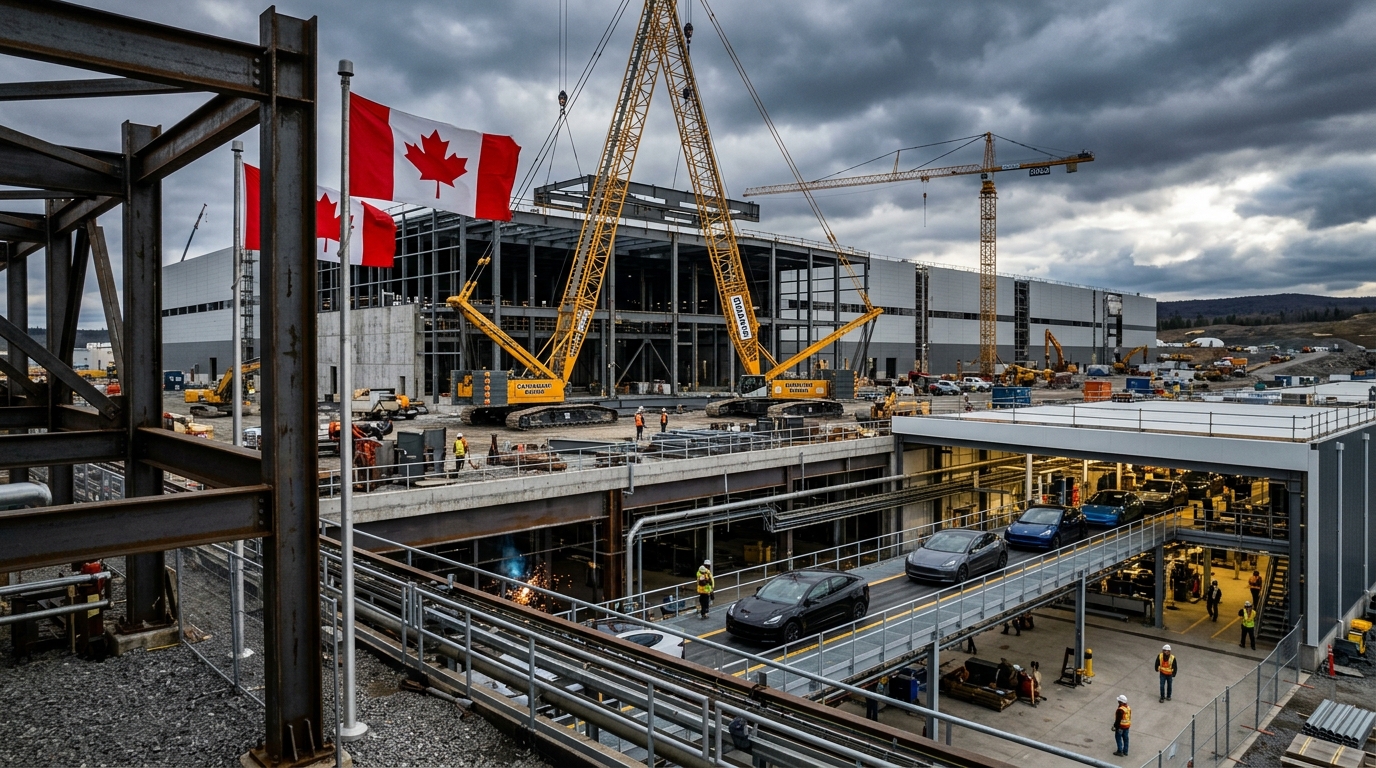
In the industrial heartland of southwestern Ontario, colossal steel skeletons and gigafactory foundations rise out of farmland in St. Thomas, Windsor, and Alliston. Over the past four years, federal and provincial governments have committed upwards of $31.4 billion in taxpayer-funded production subsidies, capital grants, and tax incentives to attract multinational electric vehicle (EV) battery manufacturing to Canadian soil. Yet, in 2026, as explored across our investigative directives on the 2026 U.S.–Canada trade war and CUSMA renegotiations, Canada’s clean grid capacity, and Ring of Fire critical mineral sovereignty, Canada’s multi-billion-dollar electric vehicle bet has collided with a harsh economic reality.
Faced with a cooling global EV consumer adoption curve, high interest rates, and aggressive international price competition, Ottawa has erected a 100% tariff wall against Chinese-made electric vehicles (including models from BYD, Geely, and SAIC). While designed to shield domestic assembly plants from state-subsidized foreign competition, this protectionist policy leaves Canadian consumers paying an average of over $67,000 for new vehicles while domestic manufacturers scramble to meet federal Zero-Emission Vehicle (ZEV) mandates. Here is the investigative financial ledger behind Canada’s auto manufacturing crossroads in 2026.
1. The $31 Billion Subsidy Ledger: What Taxpayers Pledged
To match the massive industrial incentives of the U.S. Inflation Reduction Act (IRA), Canadian federal and Ontario provincial governments structured landmark performance-based contracts for three anchor gigafactories:
- PowerCo / Volkswagen (St. Thomas, ON): A staggering $13.2 billion in performance-based production subsidies and $500 million in direct capital grants for a 90 GWh battery cell facility—the largest single investment in Canadian automotive history.
- NextStar Energy / Stellantis & LG Energy Solution (Windsor, ON): Up to $15 billion in production tax credits and capital support for a 45 GWh battery module plant, secured only after a bitter public standoff that temporarily halted construction.
- Honda EV Hub (Alliston, ON): An estimated $5 billion in federal and provincial tax credits and capital contributions supporting a comprehensive $15 billion EV and battery supply chain retooling.
2. The 100% Chinese EV Tariff Wall: Protectionism vs. Affordability
In mid-2024, Canada followed Washington by slapping a punitive 100% surtax on all Chinese-manufactured electric vehicles, alongside a 25% tariff on Chinese steel and aluminum. The economic ramifications in 2026 are profound:
- Blocking the $15,000 EV: In Europe, Latin America, and Southeast Asia, ultra-affordable EVs like the BYD Seagull (priced around $12,000 to $15,000 USD) have made electric mobility accessible to working-class families. In Canada, tariffs ensure these vehicles cannot enter the domestic market, insulating legacy automakers from price deflation.
- Dealership Lot Backlogs: While federal regulations mandate that 20% of all new light-duty vehicle sales must be zero-emission by 2026 (escalating to 60% by 2030 and 100% by 2035), Canadian auto dealers report growing inventories of expensive $60,000+ EV crossovers sitting unsold due to high monthly lease and finance payments.
- Trade Retaliation Exposure: Beijing’s immediate retaliatory anti-dumping investigations into Canadian canola exports underscore the vulnerability of Canada’s agricultural sector when federal industrial policy aligns with North American trade bloc protectionism.
3. The Auto Labour Reality: Jobs Promised vs. Jobs Delivered
Government announcements touted that EV subsidies would guarantee generational employment for over 100,000 direct and indirect Canadian auto workers represented by Unifor. However, as production lines automate:
- Battery Assembly vs. Traditional Powertrain: Electric vehicles contain roughly 30% fewer moving mechanical parts than internal combustion engine (ICE) vehicles, requiring less assembly floor labor per finished vehicle.
- The Temporary Foreign Worker Controversy: Stalled construction at Windsor’s NextStar plant sparked national outcry when specialized technical equipment required hundreds of international engineers, raising questions about domestic workforce training and technology transfer.
Canada’s EV Transition Ledger: Subsidies, Mandates & Consumer Realities (2026)
| Policy Dimension | Government Target / Projection | 2026 Economic & Consumer Reality |
|---|---|---|
| Public Financial Exposure | $31.4 Billion total committed subsidies | Tied to volume; threatened by cooling EV demand |
| 2026 Federal ZEV Sales Mandate | 20% of all new light-duty vehicle sales | Tracking at ~12%–14% nationally (Regional divide) |
| Chinese EV Tariff Protection | 100% surtax to protect domestic manufacturing | Keeps entry-level EV prices above $45,000 CAD |
| Critical Mineral Supply Chain | 100% closed-loop domestic “mine-to-mobility” | Ring of Fire infrastructure delays require imported nickel/lithium |
People Also Ask (PAA)
Why did Canada place a 100% tariff on Chinese electric vehicles?
Canada enacted a 100% tariff on Chinese EVs to protect domestic automotive manufacturing and multi-billion-dollar battery gigafactory investments from state-subsidized Chinese automakers like BYD, while aligning trade policy with the United States under CUSMA.
How much money has Canada invested in EV battery manufacturing?
Federal and provincial governments in Canada have committed over $31 billion in production subsidies, tax credits, and capital grants for battery gigafactories, including Volkswagen in St. Thomas, Stellantis-LG in Windsor, and Honda in Alliston, Ontario.
What is Canada’s 2026 EV sales mandate?
Under the federal Electric Vehicle Availability Standard, at least 20% of all new light-duty vehicles sold in Canada must be zero-emission vehicles (ZEVs) by 2026, scaling to 60% by 2030 and 100% by 2035.