
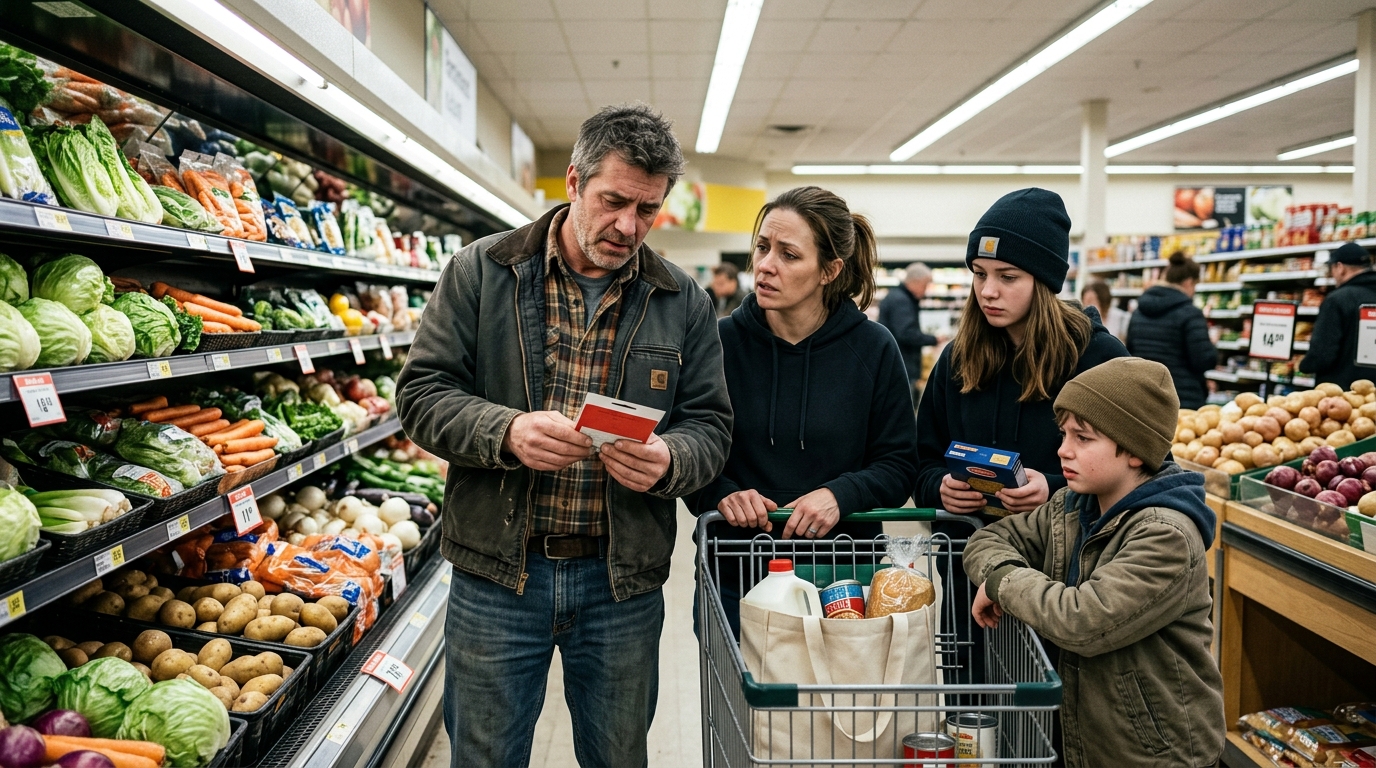
In the summer of 2023, Galen Weston Jr. — the executive chairman of Loblaw Companies Limited, Canada’s largest grocery retailer — was called before a parliamentary committee to explain why his company’s profit margins had expanded while Canadians lined up at food banks in record numbers. His testimony, carefully prepared and legally reviewed, attributed higher food prices to global supply chain costs and input inflation. What it did not address was the structural market condition that makes Canada uniquely vulnerable to food price gouging: five companies control approximately 80% of all grocery retail in Canada.
As The Northern Star has investigated across reporting on the retirement income squeeze hitting older Canadians, the healthcare cost exposures compounding household financial pressure, and the housing affordability crisis consuming disposable income, the grocery oligopoly is not a standalone consumer issue. It is one panel in a larger picture of a Canadian economy in which market concentration across multiple sectors — housing, telecommunications, banking, groceries — systematically transfers wealth upward at the expense of household purchasing power.
1. The Five-Company Structure: Market Shares and Corporate Reality
Canada’s grocery market is dominated by five retail groups, three of which are Canadian-owned:
- Loblaw Companies (Galen Weston): Loblaws, No Frills, Real Canadian Superstore, Zehrs, Provigo, Maxi, Shoppers Drug Mart (pharmacy/grocery). Market share: ~28%. 2025 grocery segment net profit: $1.4 billion.
- Empire Company Limited: Sobeys, IGA, Safeway, FreshCo, Farm Boy, Thrifty Foods. Market share: ~18%.
- Metro Inc.: Metro, Super C, Food Basics, Jean Coutu. Market share: ~12%.
- Walmart Canada: ~13% of grocery market via Supercentre superstores.
- Costco Canada: ~9% of grocery market via membership warehouse model.
Combined five-company market control: ~80%. The remaining 20% is fragmented across regional chains, independent grocers, ethnic specialty stores, and farmers’ markets — all of which face substantial competitive disadvantage in supplier negotiations, logistics, and private label pricing.
2. How Concentration Enables Price Behaviour
Economic concentration does not automatically produce illegal price-fixing. It produces something more structurally durable: parallel pricing behaviour, where dominant players in an oligopolistic market track each other’s prices closely without explicit coordination, because each knows the others will match any upward move and undercut any meaningful downward move that threatens margin.
Canada Grocery Market: Concentration vs. Consumer Impact Metrics (2026)
| Metric | Canada | US (Comparable) | UK (Comparable) |
|---|---|---|---|
| Top 5 Retailers Market Share | ~80% | ~46% | ~67% |
| Grocery Inflation (2022-2026 cumulative) | +27.4% | +21.8% | +24.1% |
| Grocery Retailer Avg Net Margin (2025) | 4.2% (Loblaw: 5.8%) | 2.9% | 3.1% |
| Grocery Code of Conduct Status | Voluntary only — Loblaw refused to sign until 2025 | Regulatory framework enforced | Mandatory code, enforced |
People Also Ask
Why are groceries so expensive in Canada in 2026?
Canada’s grocery market is dominated by five companies controlling approximately 80% of retail — one of the highest concentration rates in the developed world. This oligopolistic structure enables parallel pricing behaviour that keeps margins elevated even after input cost pressures ease.
Who owns most of the grocery stores in Canada?
Five companies control ~80% of Canadian grocery retail: Loblaw Companies (~28%), Walmart Canada (~13%), Empire Company/Sobeys (~18%), Metro Inc. (~12%), and Costco Canada (~9%).
Is Canada’s Grocery Code of Conduct mandatory?
No. Canada’s Grocery Code of Conduct, designed to protect smaller food suppliers from dominant retailers’ unfair trading practices, remains voluntary. Loblaw — Canada’s largest grocer — refused to sign until 2025 and did so only under sustained public and parliamentary pressure.